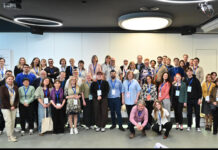



Support for civil society is not charity, it’s an investment to safeguard Europe’s democratic future.
That is how Jon Erik Strömö, Director of the Section for Central Europe and EEA Grants at the Norwegian Ministry of Foreign Affairs, opened at the official launch event for the EEA Civil Society Fund in Bulgaria – the European Economic Area and Norwegian Financial Mechanisms’ new programme for civil society support.
“And as civil society weakens, so does the democracy. Civil society acts as democracy’s first line of defense. When laws are weakened and the institution challenged, the independent civil society organisation helps safeguard rule of law, human rights and accountability”, added Strömö.
“This is not a programme that simply supports the civil sector as such. This is a programme that supports the role of civil society organisations as protectors of democracy, the rule of law and human rights. These values will be leading during the Fund’s implementation in the next 6 years,” said Georgi Stoychev, executive director of Institute Open Society – Sofia. He added that during this period many changes are likely to occur, new risks will present themselves, as well as new opportunities. “This is why we made the design of the programme so that there will be resources for support of civil society organisations during the entire period, so that they will be adaptable to potential changes in the environment and anticipate risks,” further stated Stoychev.
What will the EEA Civil Society Fund in Bulgaria look like? That was the subject of the presentation and detailed explanations provided by representatives of the Fund Operator: Elitsa Markova, Institute Open Society – Sofia, Iliyana Nikolova, Workshop for Civil Initiatives Foundation, Sara Perrine, Trust for Social Achievement Foundation and Guri Idsø Viken, Frivillighet Norge.


During the discussions, the subject of challenges and opportunities in the field of civic space and information integrity was stressed upon. Representatives from the EU Agency for Fundamental Rights, the EEA Financial Mechanism Office, the Organisation for Economic Co-operation and Development, and the civil society sector joined the panel on the topic. “And the EU has taken really a big step in its internal policy on civil society to state very clearly that civil society is a key actor for democracy, but also for resilience, democratic resilience. So there has been a rethinking at the EU level of the strategic importance of civil society and this is what we see reflected in the strategy, said Waltrud Heller from the EU Agency for Fundamental Rights.
“What we have done and what we are trying to do in this new financial mechanism, where we hear more and more on the issues that civil society organizations are facing across all the beneficiary states, is to promote the partnerships among the different stakeholders that are playing an important role in supporting civil society organizations and civic space”, said Sotiris Laganopoulos from the EEA Financial Mechanism Office.
What non-governmental organisations have done in all these years is that they have very clearly explained the state of affairs: all cases of abuse within the system, and the system’s refusal to behave in a manner consistent with the requirements of the rule of law, have been documented; they have not been hidden; they are publicly available. This is an enormous body of work, and if it had not been done, things would have been even more difficult.” This is what Yonko Grozev, former judge at the European Court of Human Rights, stated during the challenges and opportunities thematic panel discussion on the rule of law and human rights. The discussion also featured Bilyana Gyaurova-Wegertseder from the Bulgarian Institute for Legal Initiatives, Adela Kachaunova from the Bulgarian Helsinki Committee, and Tanja van Dijk from the Venice Commission, Council of Europe.
The Civil Society Fund in Bulgaria amounts to more than EUR 23 million and is fully financed by Norway, Iceland and Liechtenstein. It represents the largest commitment made to date by the donor countries to civil society in Bulgaria. By the end of 2031, the Fund is expected to support more than 300 initiatives by civil society organisations.
The operator of the EEA Civil Society Fund in Bulgaria is a consortium of civil society organisations led by the Open Society Institute – Sofia, with the participation of the Workshop for Civic Initiatives Foundation, the Trust for Social Achievement Foundation, and Civil Society Norway (Frivillighet Norge).